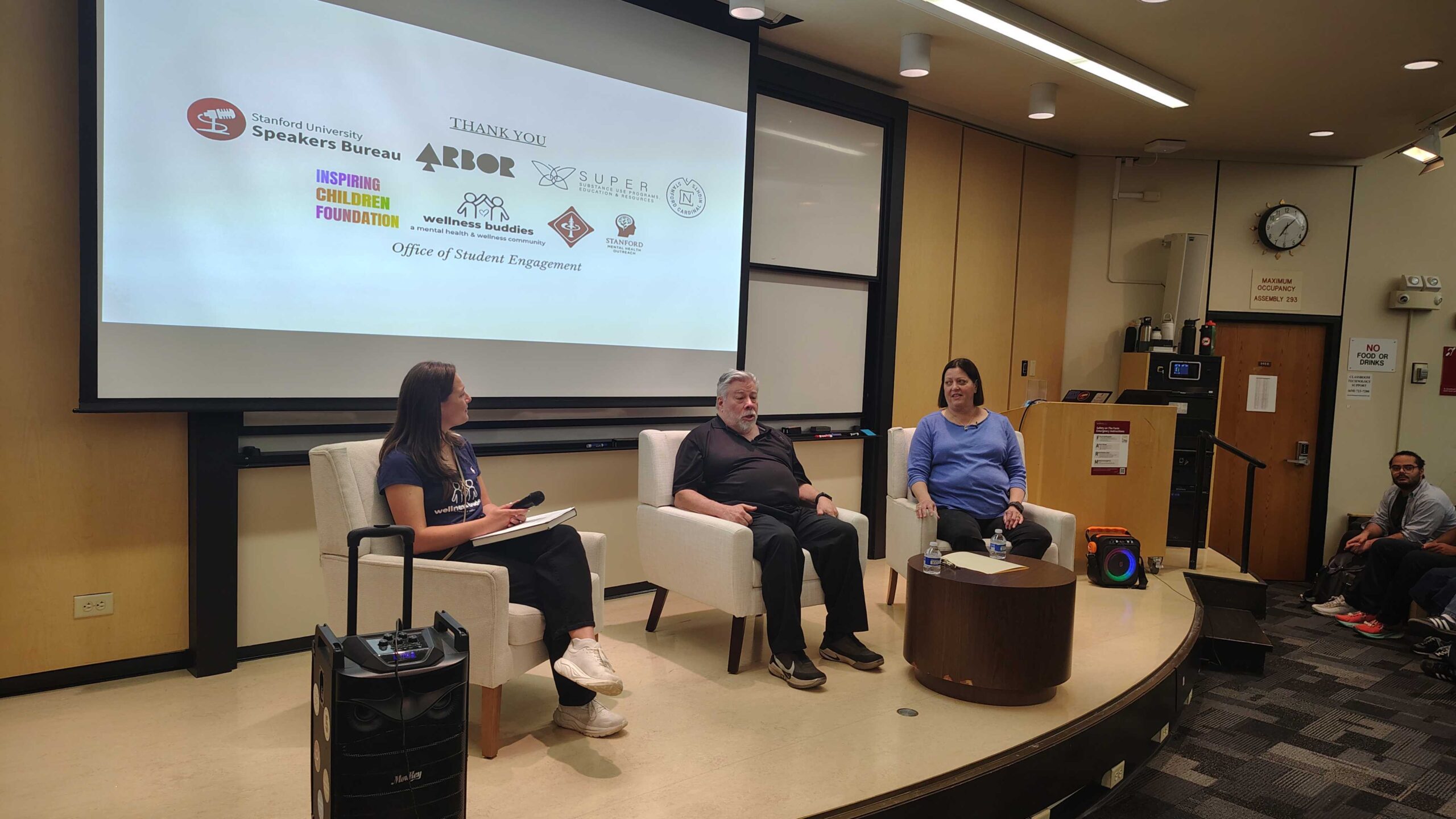
On Wednesday evening, the basement of the psychology building was packed to capacity as Apple co-founder Steve Wozniak and his wife Janet Wozniak took to the stage for “Wellbeing with Was” for a conversation centered around mental health, happiness, and the philosophy of living a fulfilling life.
The event was moderated by Sheryal O’Dell ’25, co-chair of Stanford Mental Health Outreach and Wellness Buddies, and was held in partnership with the Stanford Speakers Bureau, the Stanford Institute of Electrical and Electronics Engineers (IEEE), and the Office of Substance Use Program Education and Resources (SUPER).
O’Dell kicked off the night by promoting her mental health toolkit and social media campaign, the “Not Alone Challenge,” and then introduced Wozniak in a very personal note. She credits the couple’s mental health program, Inspiration Children’s Foundation, with saving her life after attempting suicide at age 13 while battling depression and anxiety. “They came into my life at a deeper healing stage in my journey,” she told the audience.
Asked how he has maintained his childlike wonder amidst his extraordinary success, Wozniak traced his outlook back to his teenage years. He explained that he became obsessed with digital logic after finding an engineering magazine that explained how computers process ones and zeros, even though there were no books on the subject in public libraries at the time.
Wozniak recalled walking hours home from high school as a shy kid, intent on intentionally shaping who he wanted to be and avoiding confrontations and arguments. He pointed to two principles that have guided him ever since. He is a pacifist who does not fight back when attacked, and he is determined to be kind even when others say bad things about him.
Music was the foundation, he said. While early Bob Dylan lyrics shaped his thinking, it was the line from Dave Mason’s “We Just Disagree” that became Wozniak’s personal mantra: “There’s no good people, there’s no bad people, just you and me, and we just disagree.”
Wozniak stressed that he was never driven by money or industry-building ambitions. He recalled selling about $10 million worth of company stock to about 80 Apple employees, including Dan Kocke, before the IPO because he felt his colleagues deserved to be founders. “I’ve never sold,” he said, contrasting himself with his peers who believe their true selves have been “exposed” rather than “changed” by sudden wealth.
Long before joining Apple, Wozniak told his father when he was in sixth grade that he wanted to be “an electrical engineer first and a fifth-grade teacher second.” After Apple, he fulfilled the second half of that promise, teaching fifth grade for eight years without making headlines. His advice on parenting reflected this independence. Wozniak said she was more proud than disappointed when her daughter, who had been accepted to Ivy League schools and Stanford University and was a top-ranked athlete in the country, chose to attend UCLA. “It shows what you value,” he said, adding that he taught his children that learning was more important than grades.
Janet Wozniak talks about an unconventional encounter she had on a Geek Cruise where she taught an Apple education class to about 400 participants. Steve attended her classes two years in a row in the Caribbean and the Mexican Riviera, asking her notoriously difficult questions but never speaking to her personally. “I couldn’t talk to her,” Steve admitted. “I didn’t even know her name.”
Eventually, Steve called the cruise organizers and asked them to follow up with a charity event at Janet’s home. Janet had 10 children visiting from New Jersey, most of whom were born around September 11, 2001 and had serious medical or mental health issues, through Make-A-Wish. Their hope was an Apple laptop, and their week-long visit became the foundation of Steve and Janet’s relationship.
“They say opposites attract, but we can stay together because we have something in common,” Janet says. “What we had in common was philosophy and values.”
The Wozniaks shared a series of hilarious stories. Janet detailed a recent prank in which Steve pretended to have an asthma attack weeks after he was hospitalized with COVID-19 and asthma, but said that when he actually couldn’t breathe, Steve immediately called 911, even though they kept joking.
The couple married on August 8, 2008 at 8:00 p.m. at the Segway Polo World Championship in Indianapolis. The sport helped Steve buy a Segway and popularize it among his colleagues at Apple, with whom he devised the rules as “Silicon Valley Aftershock.”
Midway through the event, Steve pulled out a pad of perforated $2 bills that were printed on a high-quality printer that met U.S. government specifications to become legal tender. He estimates he was read his Miranda rights by the Secret Service at least four times, and each time the bill remained legal.
When asked what they would leave the audience with, both Wozniaks offered guidance rooted in authenticity.
“Be honest with yourself,” Steve said. “Don’t be what others say you should be. You know that in your own heart. Follow your heart.” He recalled seeing snow for the first time in his life as a freshman, following his heart to the University of Colorado Boulder, even though he was a freshman at MIT.
Janet, who describes herself as a mathematician, computer scientist and biologist who works in a male-dominated field, told the students: “Do whatever you want to do, whatever you’re passionate about, because when you go to work, you’re going to spend a lot of time working,” she said, adding that loving what you do will make you better at it than someone competing without that passion.
Steve concluded with some words of wisdom about standing out. “Try to be better. Do things differently. Look for what others aren’t doing. What’s a different approach? … Don’t care what society says you should be.”
After the event, students remained to discuss what they had heard. Felix Llanos Horvath, a visiting scholar at Stanford University, called the talk “a really fun talk.”
“I thought they were both really kind people,” said attendee Joshua Gottschalk MS ’26. “I thought it was very interesting structurally. They didn’t have a set agenda. He wanted to show who he was and show people that you could be super famous and popular and make a lot of money and still just be a good person.”
#Healthy #Woz #Apple #CoFounder #Shares #Life #Philosophy #Mental #Health #Event