![Young people participate in digital detox activities at the National Youth Internet Dream Village in Seoul in 2025. [National Center For Youth Internet Addiction Treatment]](https://drouki.com/wp-content/uploads/2026/05/Device-Detox-Fighting-Digital-Fatigue-in-a-Hyper-Connected-South-Korea.jpg)
Young people participate in digital detox activities at the National Youth Internet Dream Village in Seoul in 2025. [National Center For Youth Internet Addiction Treatment]
The irresistible allure of a sleek, rectangular device with access to a bottomless feed curated by customized algorithms has sparked a reactionary impulse in some South Koreans.
Digital detox, also known as digital fasting, is when an individual intentionally disconnects from their devices for an extended period of time, and is an emerging habit among Koreans looking for an antidote to doomscrolling. These detox locations come in all shapes and sizes, from quaint coffee shops to places of worship.
Cafes in Seoul are filled with people sipping tall Americanos while tapping on their computers or scrolling on their phones. If your head isn’t buried in your device’s content, you’re probably taking a photo or recording a video.
But on May 12, at COUCH Coffee in Yongsan District near Seoul Station, the only thing in use was an espresso pack while owner Kim Jun-ho brewed another flat white.
That’s because when Kim opened the cafe a few years ago, he banned the use of devices in the cafe.
![May 12th, COUCH Coffee storefront in Yongsan-gu, central Seoul [Fergus Goodall Smith]](https://drouki.com/wp-content/uploads/2026/05/1779678745_551_Device-Detox-Fighting-Digital-Fatigue-in-a-Hyper-Connected-South-Korea.jpg)
May 12th, COUCH Coffee storefront in Yongsan-gu, central Seoul [Fergus Goodall Smith]
“In Korea, there are many ways to distract yourself from screen time and dopamine release, but cafe culture doesn’t offer that. So we wanted to introduce coffee as a way to escape.” [from devices]” said Kim.
Kim believes that Korean cafes are no longer about coffee but social media. “The focus is on the cafe, not the coffee. I want the focus to be on the coffee, or the taste,” he said, going back to the basics.
“Social media, Instagram, YouTube, I think it’s a drug,” Kim said. “It’s very short, there’s nothing for me, and I don’t have time.”
Several young Koreans spoke about their screen time worries, mainly caused by short-form media and calculated algorithms. Experts warn that screen time use can have harmful side effects such as increased stress and sleep disruption, pointing to these drawbacks as evidence of the growing demand for digital detox.
screen time tribulations
Walking around Yonsei University’s campus in central Seoul, it’s hard not to notice something in common among the students enjoying the last rays of sunlight on a warm May 8 evening.
“I’m an addict,” said university student Han Ju. She told Korea JoongAng Ilbo that she spends a lot of time on her devices, especially short-form social media platforms like YouTube Shorts.
Han said she has been trying to reduce her screen time, but the methods have not been effective. “It can be frustrating because I’m always trying to limit screen time and always failing.”
Kim Jae, another student at Yonsei University, explained that when she was young, touch screens and social media weren’t what they are today. At that time, smartphones were not yet very popular. For the younger generation, modern technology is always present, he explained.
![Students make phone calls at Yonsei University in Sinchon-dong, central Seoul, on May 15. [Fergus Goodall Smith]](https://drouki.com/wp-content/uploads/2026/05/1779678745_71_Device-Detox-Fighting-Digital-Fatigue-in-a-Hyper-Connected-South-Korea.jpg)
Students make phone calls at Yonsei University in Sinchon-dong, central Seoul, on May 15. [Fergus Goodall Smith]
A study published in March by the academic journal Psychiatry Research found that out of 231,292 participants, 57 percent of South Korean adolescents aged 12 to 18 used their smartphones for more than four hours a day, and the more time they spent on their devices, the more likely they were to feel lonely, depressed, and stressed.
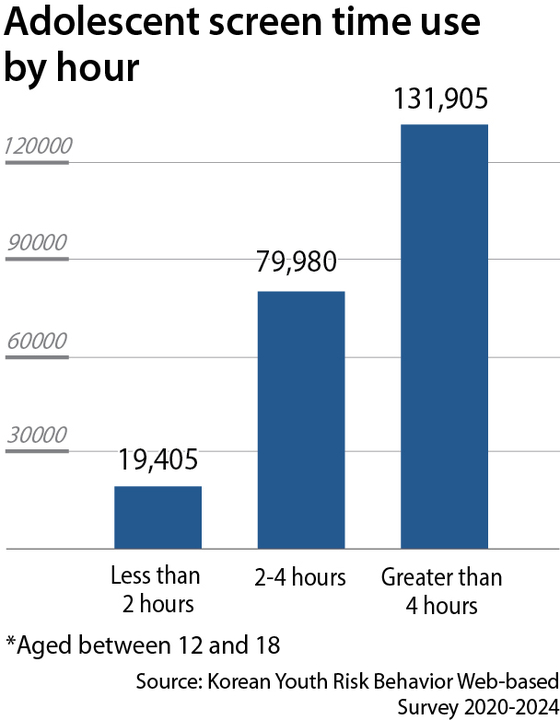
Kim Eun-kyung, a professor at Korea University’s School of Nursing, said recent research in Korea and abroad suggests that excessive screen exposure is increasingly associated with mental health burdens, especially among adolescents and young adults.
Professor Kim said South Korea is a particularly interesting example because screen overuse is not just a problem for entertainment.
“Hyperconnectivity in South Korea is like a double-edged sword,” Professor Kim said.
“There is no doubt that it has contributed to economic growth, technological innovation and social convenience, but it has also made social and professional disconnection more difficult.
South Korea’s competitive culture can put intense pressure on you to stay informed and productive. As a result, digital devices often serve not only as work and study tools, but also as a means of emotional escape and stress relief. ”
![Screen time statistics provided by an anonymous user on May 18th. [Fergus Goodall Smith]](https://drouki.com/wp-content/uploads/2026/05/1779678746_304_Device-Detox-Fighting-Digital-Fatigue-in-a-Hyper-Connected-South-Korea.jpg)
Screen time statistics provided by an anonymous user on May 18th. [Fergus Goodall Smith]
Professor Kim’s remarks reflected the experiences of students like Han.
Lee Ga-young, a counselor at the Gyeonggi branch of the Internet Addiction Prevention Center (IAPC), told Korea JoongAng Ilbo that there is certainly a demand for counseling from university students.
IAPC is a South Korean agency focused on preventing over-reliance on smartphones and the internet. We offer free counseling services to callers.
He said not everyone necessarily has serious dependencies on their devices. “Some people simply want to use their phones more carefully, while others are dealing with more serious issues and want to solve them. There are different groups.”
Professor Kim cautioned against viewing raw screen time data as a measure of harm or risk. While some people may be spending too much time looking at screens, the concern is that it’s addictive and compulsive behavior.
Choose Detox
Publicly funded detox programs are another option. National Youth Internet Dream Village in Muju-gun, Jeollabuk-do runs year-round overnight camps specializing in digital detox and healthy device use.
Dream Village manager Shin Yong-cheol said the camp has been operating since 2014, with 22 people per year, 24 people in each cohort. Singh said the camp is designed for young people who have more serious addiction issues with devices. “A significant portion of the students in the camp are so dependent on their mobile phones that they refuse to go to school,” Singh said.
![Young people participate in detox activities at the National Youth Internet Dream Village in Seoul in 2025. [National Center For Youth Internet Addiction Treatment]](https://drouki.com/wp-content/uploads/2026/05/1779678746_122_Device-Detox-Fighting-Digital-Fatigue-in-a-Hyper-Connected-South-Korea.jpg)
Young people participate in detox activities at the National Youth Internet Dream Village in Seoul in 2025. [National Center For Youth Internet Addiction Treatment]
The camp acts as a kind of rehabilitation center for young people. Participants’ dependence on smartphones and other devices is interfering with their daily lives.
Another online detox space is GoDok Stay, located along Gyeonggi Line Book Street in Hongdae. GoDok was founded as a place for customers to feel alone. Participants literally lock their devices in a cage and focus on mindfulness activities for two hours in a sort of mini-temple stay.
GoDok Stay recently closed, but Shijun, a friend of the owner who currently works in the space, said it’s difficult to monetize activities like this.
![A hidden entrance to the former GoDok Stay "digital fasting center " on May 15th in Hongdae, west of Seoul. [Fergus Goodall Smith]](https://drouki.com/wp-content/uploads/2026/05/1779678748_54_Device-Detox-Fighting-Digital-Fatigue-in-a-Hyper-Connected-South-Korea.jpg)
A hidden entrance to Godok Stay, a former “digital fasting center” in Hongdae, west of Seoul, on May 15. [Fergus Goodall Smith]
Shijun said customers want “human connection” rather than just being alone without their devices. She currently uses GoDok Stay for “social journaling.” Friends and strangers gather together to write diaries, almost like a small think tank. Ideas are usually focused on your career, goals, and passions.
Shijun said journaling is a way for people to share ideas and advice without having to immediately seek help from, say, an AI chatbot.
Unplugged, a Hongdae-based cafe, doesn’t have a strict device ban, but is unique in that it serves as a space for creative expression, welcoming musicians to practice their music (usually acoustic guitar) while sipping coffee and disconnecting from their devices.
Most of the customers who come into the store are either busy bouncing ideas off each other with guitars in hand, or simply seem lost in thought as they quietly strum their guitars. Only the owner has the laptop.
![On May 8, an unplugged cafe in Hongdae, west of Seoul, where customers can find an outlet for their creativity. [Fergus Goodall Smith]](https://drouki.com/wp-content/uploads/2026/05/1779678753_980_Device-Detox-Fighting-Digital-Fatigue-in-a-Hyper-Connected-South-Korea.jpg)
On May 8, an unplugged cafe in Hongdae, west of Seoul, where customers can find an outlet for their creativity. [Fergus Goodall Smith]
back to basics
Some people choose more traditional methods of mindfulness.
Jun Yerin, a student at Yonsei University, says church is her way of detoxing. “When I go to church every Sunday, I usually don’t use my cell phone for eight or nine hours.”
Jun said that being away from his devices for so long made him feel like a more social person. “I feel like I’ve been able to connect with more people. It’s been a detox.”
Professor Kim said Seoul is gradually seeing more cafes and other areas that double as wellness-oriented spaces, as well as mindfulness programs that encourage visitors to reduce their smartphone use and increase their presence in offline environments.
“There also seems to be a growing public interest in balancing online and offline lives,” Kim said.
Detoxing isn’t just about getting away from screens. It’s about carving out time to be present and let your thoughts wander without risking being trapped by an algorithm.
It remains to be seen whether digital detox will become mainstream, but it’s clear that more and more people are looking for a break from screen time.
Kim Jun-ho of COUCH Coffee believes that Koreans need more moments like this.
“Most of the time, Koreans can’t even think,” he says. “We should take time to be alone and be present. I just wanted to tell people, maybe we need that.”
Written by Fergus Goodall Smith [[email protected]]
#Device #Detox #Fighting #Digital #Fatigue #HyperConnected #South #Korea